
Lucky Block Crypto Casino Payments
 Available in US
Lucky Block is built around cryptocurrency payments and currently promotes support for more than 20 cryptocurrencies for deposits and withdrawals. Its Help Centre documents major assets and networks including Bitcoin, Ethereum, Litecoin, Dogecoin, USDT, XRP, Cardano, BNB, Solana and USDC. The exact options visible to an account can change, so the Wallet remains the final place to confirm a particular asset and network.
For Australian readers, this crypto-first model should not be confused with direct AUD banking. Cryptocurrency use for payments remains relatively niche in Australia compared with services such as PayID, so Lucky Block’s cashier may feel different from a locally familiar bank-led payment flow.
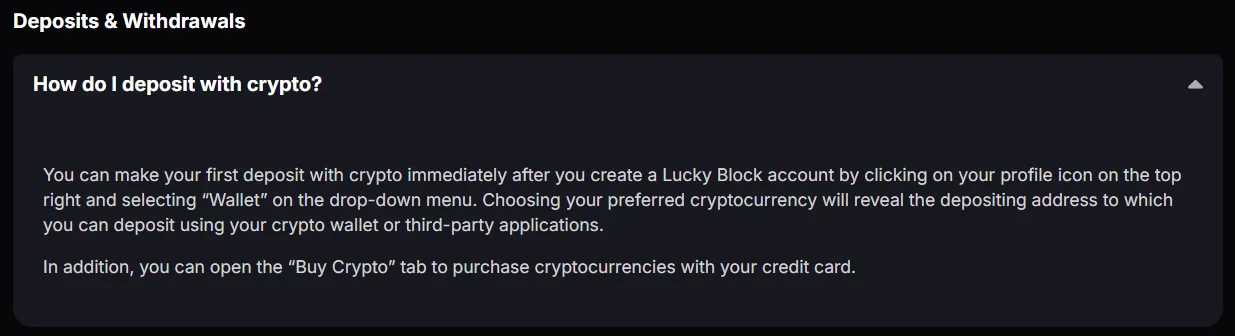
Table of Contents
- Which cryptocurrencies does Lucky Block support?
- How a Lucky Block crypto deposit works
- Why the network matters as much as the coin
- Blockchain confirmations explain many pending deposits
- What does Lucky Block charge for crypto payments?
- Crypto is not the same as an AUD cashier
- Should you use a stablecoin?
- Depositing and withdrawing should use one coherent plan
- Buying crypto by card changes the cost calculation
- Crypto transfer mistakes are hard to undo
- Mobile use can make wallet checks more important
- Frequently asked questions
- Crypto works best when every step is deliberate
Which cryptocurrencies does Lucky Block support?
Lucky Block promotes support for more than 20 cryptocurrencies. Its current payment information includes established assets and stablecoins such as BTC, BCH, LTC, DOGE, ETH, USDT, TRX, XRP, ADA, BNB, SOL and USDC. The list is broad enough to make crypto a core part of the product rather than a small alternative payment category.
That said, a published list should be treated as a set of current examples, not a permanent promise that every asset and network will be available in every account. Crypto payment menus can change as networks, tokens and payment providers evolve.
| Asset example | What to check before sending | Why it matters |
|---|---|---|
| Bitcoin | Bitcoin address and current minimum | Sending to the wrong chain or below the minimum can cause loss |
| Ethereum or ERC-20 token | Exact token and ERC-20 network support | Token name alone does not confirm network compatibility |
| USDT | Which USDT network is shown | USDT exists on multiple networks that are not interchangeable |
| BNB | Network shown by the receiving wallet | BEP-20 and other network formats require matching support |
| Solana-based asset | Solana address and supported token | The destination has to accept the same network and asset |
How a Lucky Block crypto deposit works
Lucky Block’s Help Centre describes a wallet-based process. After signing in, you open the Wallet, select a cryptocurrency and use the deposit address shown for that asset. Funds are then sent from your own crypto wallet or another service that can transfer the selected currency over the correct network.
- Open the Lucky Block Wallet. Start from the current account interface rather than an address saved from a previous transfer.
- Select the cryptocurrency. The Wallet displays the deposit information for that asset.
- Check the network. The sending wallet must use the same chain that Lucky Block expects for the receiving address.
- Read the current minimum. Lucky Block says the minimum deposit is shown after the asset is selected.
- Send from a compatible wallet. Review the address carefully before confirming the transaction.
- Wait for confirmations. The deposit can remain pending until the required blockchain confirmations are reached.
Lucky Block also describes a Buy Crypto option that can be used to purchase cryptocurrency with a credit card. That is different from a direct card casino deposit: the card is used to buy crypto, and the resulting crypto is then part of the account funding flow.
Why the network matters as much as the coin
One of the biggest practical differences between crypto and conventional card or bank payments is that an asset can exist across more than one network. A familiar token name does not tell you which chain the receiving address supports.
USDT is a simple example. A wallet may offer USDT over several networks, but Lucky Block’s current account instructions may expect a particular one. Sending the right token through the wrong network can result in a failed or unrecoverable transfer.
Before every deposit, compare three things together: the asset, the network and the destination address. Treat all three as one payment instruction. If any one of them does not match, stop before sending.
Blockchain confirmations explain many pending deposits
A crypto transfer can be broadcast successfully without being credited immediately. Lucky Block’s Help Centre says deposits may remain in an initiated state while the required blockchain confirmations are completed. The required number and expected time differ by currency and network.
This is why a pending deposit should be diagnosed in the right order. First check whether the transaction exists on-chain. Then check whether it has enough confirmations. Only after that should you treat the issue as a casino account credit problem.
A blockchain explorer can help distinguish these stages. It shows whether the transfer was broadcast, where it was sent and how many confirmations it has received. It does not, however, replace the casino’s own account status.
What does Lucky Block charge for crypto payments?
Lucky Block says it does not charge deposit or withdrawal fees. Crypto transactions can still cost money because the blockchain or a third-party provider may impose its own fee. If you buy crypto through another service before depositing, that purchase can also include a fee or spread.
This creates a useful distinction between a zero casino fee and a zero-cost transaction. They are not the same thing. A low-value transfer can be disproportionately expensive when network charges are high, while another asset or network may be cheaper at the same moment.
If cost matters, compare the total amount spent to move and convert the funds, not only the fee line inside Lucky Block.
Crypto is not the same as an AUD cashier
Lucky Block’s crypto support does not establish direct Australian-dollar deposits or withdrawals. If you buy cryptocurrency with AUD through an exchange, card service or another provider, the AUD-to-crypto conversion happens outside the core crypto transfer itself.
That difference matters because Australians are used to payment methods built around local currency. Reserve Bank data from the 2025 Consumer Payments Survey shows that around half of respondents had used PayID in the prior year, while only around 2% reported using cryptocurrency to make a payment. Crypto therefore remains a relatively niche payment method in everyday Australian consumer behaviour.
For Lucky Block, however, crypto is central rather than niche. That contrast is one of the site’s clearest payment characteristics. The broader guide to Lucky Block payments explains why Australian payment popularity should not be mistaken for cashier support.
Should you use a stablecoin?
Some users prefer stablecoins because they are designed to track a reference asset such as the US dollar more closely than volatile cryptocurrencies like Bitcoin or Ethereum. That can make budgeting easier, but it does not remove every risk or cost.
You still need the correct token and network, and you still need to understand any wallet, exchange or provider charges. Stablecoins can also differ in liquidity, network support and technical implementation. The practical benefit is mainly reduced price movement relative to highly volatile coins, not the elimination of payment risk.
For an Australian player budgeting in AUD, a stablecoin can reduce one layer of volatility after conversion, but the original AUD purchase rate and any later conversion back to AUD still matter.
Depositing and withdrawing should use one coherent plan
It is easy to focus on the deposit because that is the first payment action, but crypto works best when you know how the funds will leave as well. Before depositing, decide which wallet you expect to use for a withdrawal and confirm that it supports the same asset and network.
The guide to Lucky Block withdrawals covers current payout timing, fees, transaction reviews and blockchain tracking. A fast crypto deposit does not guarantee an equally fast payout.
Buying crypto by card changes the cost calculation
Lucky Block’s Help Centre describes a Buy Crypto tab for purchasing cryptocurrencies with a credit card. This can make crypto easier to access for someone who does not already hold it, but it adds another provider to the transaction chain.
That provider may apply pricing, verification requirements, card acceptance rules or a spread that is separate from Lucky Block. The card purchase should therefore be evaluated as a crypto acquisition step, not simply as a conventional casino card deposit.
Before using it, compare the quoted crypto amount with the card amount you are paying. That gives you a clearer view of the effective purchase cost than looking only for a visible fee label.
Crypto transfer mistakes are hard to undo
Conventional bank payments sometimes offer familiar dispute or reversal processes. Blockchain transfers are different. Once a transaction has been confirmed to the wrong address or over an unsupported route, recovery can be difficult or impossible.
- Copy the receiving address from the current Wallet rather than reusing an old one.
- Check the first and last characters after pasting the address.
- Match the network exactly.
- Stay above the displayed minimum.
- Use a cautious first transfer when a route is unfamiliar and the minimum allows it.
- Keep the transaction hash until the deposit or withdrawal is fully settled.
These steps are simple, but they address the mistakes that matter most in a crypto-led cashier.
Mobile use can make wallet checks more important
Crypto deposits are often completed across two apps or browser tabs: Lucky Block on one side and a wallet or exchange on the other. On a phone, copying addresses and switching networks quickly can make it easier to overlook a mismatch.
Take the extra few seconds to verify the selected chain and address before sending. The guide to Lucky Block mobile looks at the wider mobile experience and the practical trade-offs of using the site on a smaller screen.
Frequently asked questions
How many cryptocurrencies does Lucky Block support?
Lucky Block currently promotes support for more than 20 cryptocurrencies for deposits and withdrawals. The exact asset and network options should still be checked in the live Wallet.
Which cryptocurrencies can I use at Lucky Block?
Current documented examples include BTC, BCH, LTC, DOGE, ETH, USDT, TRX, XRP, ADA, BNB, SOL and USDC, among others.
Does Lucky Block charge crypto deposit fees?
Lucky Block says it does not charge deposit or withdrawal fees. Network, mining and third-party provider charges can still apply.
Can I buy crypto with a card?
Lucky Block’s Help Centre describes a Buy Crypto tab that can be used to purchase cryptocurrency with a credit card. The purchase provider can have its own pricing or requirements.
Is PayID available at Lucky Block?
PayID is widely used in Australia generally, but that does not establish it as a Lucky Block payment method. Only treat it as supported if it appears in the live cashier.
Crypto works best when every step is deliberate
Lucky Block’s crypto-first setup is a genuine product difference: it supports a broad range of assets, promotes more than 20 cryptocurrencies and builds deposits around wallet addresses and blockchain networks. For users already comfortable with crypto, that can be straightforward. For users coming from Australian bank payments, the learning curve is mainly about networks, confirmations and external fees.
The safest routine is to verify the asset, chain, address and minimum every time, then keep track of the transaction until it is confirmed. Once you understand that flow, return to the Lucky Block Australia review to compare crypto payments with bonuses, games, mobile use and the rest of the account experience.
Prepared by the Lucky Block Casino editorial staff.
