
Anonymous Crypto Casinos in Australia: Payments and Risks
 Available in AU
Bitcoin transfers can be hard to reverse, while wallet addresses alone do not establish who controls them or make casino activity anonymous.

Table of Contents
- What Bitcoin Payments Can—and Cannot—Tell You
- Anonymity Does Not Remove the Legal and Safety Risks
- Online Casino Access and the Limits of Anonymity
- Deposits, Bonuses and the Tax Consequences of Crypto
- How to Judge a Casino’s Risks Without a Ranking
- Why Casino Domains Can Disappear
- Crypto Options Beyond Bitcoin
- Casino Apps, Monitoring and Changing Access
- Why Older Casino Lists Can Quickly Become Out of Date
- What to Check Before Considering a New Casino
What Bitcoin Payments Can—and Cannot—Tell You
Bitcoin is one of the main payment options named by offshore crypto casinos, and it is supported by almost all of them. That makes it a familiar choice when a casino accepts cryptocurrency. It does not, by itself, tell you whether a particular operator is trustworthy, whether a withdrawal will be straightforward, or whether your activity is anonymous.
A Bitcoin payment moves value between wallet addresses on the Bitcoin network. The casino may display an address or payment instruction for a deposit, and a withdrawal may send Bitcoin to an address you provide. These are not the same as paying by card: you need to pay attention to the address and the network, and a mistaken transfer may be difficult or impossible to reverse. Check the payment details carefully before sending funds, including that the casino and your wallet are both using Bitcoin rather than a different network or currency.
The word “anonymous” in a casino’s description should not be read as a feature guaranteed by Bitcoin. A wallet address is not a name, but that does not establish who controls it or conceal every link between a payment and its owner. The casino may also have its own account, verification or withdrawal procedures. Bitcoin tells you what payment method is being used; it does not tell you what information the operator may request or retain.
When considering an anonymous crypto casino in Australia, you can use this list to check the limited available details about each operator. Treat the information as a starting point and verify the terms that matter to you before signing up.
License: Curacao You can note that Golden Pokies is listed with a Curacao licence.
License: Curacao Gaming Control Board OGL/2023/176/0095 (Hollycorn N.V.) You can note GoldenCrown’s stated Curacao Gaming Control Board licence, OGL/2023/176/0095, held by Hollycorn N.V.
License: Curacao · Min. deposit: A$20 (POLi) You can note Lucky Dreams’ Curacao licence and A$20 minimum deposit via POLi.
License: Curacao eGaming OGL/2023/174/0082 (Dama N.V.) · Min. deposit: A$15 You can note LevelUp Casino’s Curacao eGaming licence, OGL/2023/174/0082, held by Dama N.V., and its A$15 minimum deposit.
License: international iGaming licence – jurisdiction not named in the source · Payout speed: PayID 1-24 hours · Min. deposit: A$30 (PayID from A$10) You can note House of Pokies’ stated international iGaming licence, though the source does not name its jurisdiction. PayID withdrawals are listed at 1–24 hours, and the minimum deposit is A$30, or A$10 when using PayID.
License: Curacao eGaming (Roby Games Ltd) You can note that Roby Casino is listed with a Curacao eGaming licence held by Roby Games Ltd.
License: Curacao (operating since 2017) · Min. deposit: A$20 You can note Uptown Pokies’ Curacao licence, operation since 2017, and A$20 minimum deposit.
License: Curacao, operated by Dama N.V. You can note that 7Bit Casino is listed with a Curacao licence and is operated by Dama N.V.
License: Curacao · Payout speed: crypto 30-60 minutes, fiat 1-5 days · Min. deposit: A$10 You can note Wild Tokyo’s Curacao licence, A$10 minimum deposit, and listed payout times: 30–60 minutes for crypto and 1–5 days for fiat.
License: Tobique Gaming Commission · Payout speed: crypto ~10-15 minutes, fiat 1-5 days · Min. deposit: A$30 You can note SkyCrown’s Tobique Gaming Commission licence and A$30 minimum deposit. Listed payout times are around 10–15 minutes for crypto and 1–5 days for fiat.
What the transaction can show
A Bitcoin transfer can help you follow whether funds have moved between addresses, but it cannot settle every question about a casino payment. A transaction record does not prove that the operator will credit a deposit correctly, approve a withdrawal, or respond if there is a dispute. Those outcomes depend on the operator’s processes, not simply on the currency.
There can also be a difference between the amount you intend to send and the value you ultimately receive or spend. Bitcoin’s value can change while you are depositing or withdrawing. If the price moves between those points, the same amount of BTC may represent a different value in Australian dollars. Consider that exposure before choosing Bitcoin for a payment, especially if you are relying on a particular dollar value.
A withdrawal has several parts: the casino must process it, the payment must be sent to the right address, and the transfer must be recognised by the network. Seeing a payment marked as processed by the casino is not necessarily the same as seeing it arrive in your wallet. Keep the casino’s transaction details and your own records so you can distinguish an operator-side delay from a transfer that has already been sent. Do not assume that a Bitcoin withdrawal will arrive on a timetable just because a casino advertises crypto payments.
A specialist review describes Bitcoin as a fit for larger, less frequent cashouts when waiting half an hour is not a concern. Treat that as a preference, not a promise about processing time. The casino’s handling of a withdrawal and the network conditions can affect what happens, and an individual review cannot establish how a particular payment will be handled for you. If timing matters, check the operator’s stated process before making a deposit rather than relying on a general description of Bitcoin.

What Bitcoin cannot guarantee
Using BTC does not guarantee that the casino will accept a withdrawal without further checks, that the exchange value will remain stable, or that a payment will be recoverable if the address is wrong. Nor does a crypto-only cashier prove that a service is private or safe. Those are separate questions from whether Bitcoin is accepted.
Before transferring funds, make sure the casino’s payment instructions match the wallet you intend to use. Confirm the address and the Bitcoin network at both ends, and pause if anything differs. A transfer sent to an incompatible address or network may not be recoverable. Also check how the operator describes deposits and withdrawals, including whether it may apply conditions or request information before releasing funds. Do not treat the word “anonymous” as a substitute for reading those details.
Bitcoin can therefore tell you something practical: the payment is being made in BTC, through a network with its own transfer process and price movements. It cannot tell you that the operator will honour a withdrawal, that the value will stay the same, or that your identity is beyond scrutiny. Keep those limits in view when weighing a Bitcoin payment.
Attention: A Bitcoin transfer does not guarantee that an operator will honor a withdrawal or that your identity remains completely hidden from the service provider.
Anonymity Does Not Remove the Legal and Safety Risks
A crypto payment does not change the legal position of online casino gambling in Australia. The Interactive Gambling Act 2001 prohibits operators from providing real-money online casino games to people in Australia. That includes services offered from offshore: using a cryptocurrency or opening an account with a foreign operator does not bring the service within Australia’s regulatory framework.
The distinction between an operator’s obligations and a player’s position matters. Offshore crypto casinos are not licensed in Australia, and the law targets the providers of prohibited services rather than individual players. It is not a criminal offence for an Australian resident to access an offshore online casino, and it is not illegal for an individual to gamble there. That does not mean the operator is approved, supervised or protected by Australian rules.
Nor does the absence of criminal liability for a player amount to a recommendation or assurance of safety. If you are considering a service described as an anonymous casino, treat the word “anonymous” as a claim about its sign-up or payment process, not as evidence that the service is lawful in Australia or accountable to Australian authorities. Crypto does not create a special legal exception.
What Australian oversight does—and does not—mean
The Australian framework does not license offshore crypto casinos to offer online casino games to people in Australia. Because these services operate outside that framework, Australian authorities do not regulate them as domestic casino services or provide the consumer protections associated with Australian oversight. A foreign licence, if an operator claims to have one, does not make it licensed in Australia.

This is important when something goes wrong. A payment method may record a transaction, but it does not establish that the casino is authorised here or give you Australian consumer protection. Likewise, a site’s statements about fairness, privacy or its own rules do not replace Australian regulation. Do not read a smooth account-opening process as official approval.
The legal position is separate from the practical issues of using an offshore service. Whether a site can be reached, what information it asks for and how it handles an account are distinct concerns; none changes the underlying prohibition on operators providing these services to people in Australia. The point here is narrower: crypto does not make an offshore casino Australian-licensed, and the player’s lack of criminal liability does not turn the operator into a regulated local provider.
Age and identity are separate questions
You must be at least 18 to gamble. A no-KYC or anonymous label does not remove that requirement. Nor should you assume that paying with cryptocurrency means identity checks will never apply. An operator may still ask for identity information, and describing a service as anonymous cannot guarantee that you will not be asked to verify who you are.
These are separate issues: meeting the age requirement does not make an offshore casino licensed in Australia, while a crypto payment does not alter the age rule or the operator’s legal position. If you are under 18, do not gamble.
It is possible to recognise both sides of the legal distinction without confusing them. An individual is not committing a criminal offence simply by accessing an offshore online casino, but the operator is still outside Australia’s regulatory framework. That framework provides no Australian consumer protection for the service. A claim of anonymity cannot bridge that gap, and it should not be treated as proof that using the service is free of risk.
Legal Status
Offshore crypto casinos are not licensed in Australia, and using them means you have no access to Australian consumer protections.
Online Casino Access and the Limits of Anonymity
An offshore casino may describe its service as anonymous or no-KYC, but those labels do not establish what information you will need to provide or what the operator may later request. A crypto payment can change how funds move; it does not, by itself, make an account anonymous. Before creating an account, read the site’s identity and privacy terms rather than relying on a slogan or a payment option.
Some services may let you register with limited details at first, then ask for identity documents when you request a withdrawal or when they need to review an account. A check may also be required to confirm age: you must be at least 18 to gamble. If you are not prepared to provide information when asked, you could find that you cannot complete the process you expected. Do not assume that an account advertised as no-KYC will remain free of checks.
Consider what you would be comfortable sharing and how the operator says it handles that information. Read the privacy policy and account terms for details about identity checks, data handling and the circumstances in which access may be restricted. If those explanations are unclear, contradictory or difficult to find, treat that as a reason to pause. The absence of a request during registration is not a promise that no request will follow.

It is also worth separating privacy from protection. Offshore crypto casinos are outside Australia’s regulatory framework, so Australian authorities do not provide consumer protection for their services. A site’s own claims about confidentiality do not change that position. If a dispute arises over account access or a request for documents, you may have limited practical ways to resolve it.
The phrase “anonymous casino online” can suggest that a player’s identity is hidden from everyone. That is too broad an assumption. A casino account is still an account held with a service provider, and using cryptocurrency does not guarantee that the operator will not seek identifying information. Nor does a crypto transaction make every part of your online activity private. Treat anonymity as a claim to examine, not a status you can secure simply by choosing a particular payment method.
There is a further distinction between what a casino asks from you and what can be observed by regulators. The Australian Communications and Media Authority actively monitors online gambling activity, including activity involving cryptocurrencies. That is another reason not to treat crypto use as a way to become invisible. It does not mean that every individual transaction will result in a particular action; it does mean that a crypto payment should not be mistaken for a guarantee of privacy.
Before you proceed, check the operator’s terms while you can still make a considered choice. Look for clear language about when identity checks may happen, what documents may be requested, and how access to an account may be affected if you do not provide them. Keep your expectations modest: a low-detail sign-up is not the same as lasting anonymity, and a claim of privacy is not independently verified protection.

If you are comparing services described as anonymous online casinos, avoid treating a “best” label or a no-KYC promise as proof that the service will suit your privacy needs. The relevant question is not simply whether you can open an account with few details. It is whether you understand the information the operator may require later, and whether you are willing to accept the uncertainty that comes with an offshore service.
Deposits, Bonuses and the Tax Consequences of Crypto
A low minimum deposit can make an offer look easier to try, but it does not tell you what a bonus is worth or what a crypto transaction may mean for your tax records. Treat the deposit threshold, the bonus terms and the tax consequences as separate questions. A no-deposit offer does not remove the need to understand any of them.
Deposit figures vary between operators and can change. One specialist review reports that deposits at the casinos it examined can start at $5. A specialist review describing minimums across operators gives a different picture: AUD 15 to AUD 30 as the equivalent deposit range, with Bitcoin minimums often reported at AUD 30 to AUD 50. These are reported figures, not a promise that a particular casino will accept that amount today. Check the payment page and terms before sending funds, and make sure the stated minimum applies to the cryptocurrency and network you intend to use.
A no-deposit bonus may appear to avoid that first payment, but “no deposit” does not mean “no conditions” or “no financial consequences”. Read the offer’s terms before accepting it. Establish what the offer permits, what steps are required before any withdrawal, and whether the casino can change or withdraw the promotion under its rules. Do not assume that a bonus balance is cash you can withdraw, or that an offer makes an offshore service safe or protected. If the conditions are unclear, do not rely on the promotion when deciding whether to create an account or provide payment details.

Crypto brings a separate issue: Australian tax treatment can depend on what happens to the asset, not just on whether gambling produced a win. Recreational gambling winnings are generally not taxed as ordinary income. But that does not mean every crypto transaction connected with gambling is tax-free. The ATO treats cryptocurrency as a capital gains tax asset, and disposing of it may have CGT consequences.
A deposit can count as a disposal. If you transfer crypto to a casino, that transaction may itself be a CGT event, separate from any gambling result. That means a deposit can have tax implications even if you do not win, or if the funds are later lost. Keep records of the amount of crypto transferred, its value when you acquired it and its value when you deposited it. Records can help you work out what happened if you later need to calculate a gain or loss.
A bonus does not change the need to keep those records. Nor should a promotional balance be confused with crypto you own or with a gambling win paid in crypto. If a win is paid in cryptocurrency, the rules for the later disposal of that crypto can matter: selling, swapping or spending it may trigger CGT rules. The crypto’s value when you receive the win becomes its cost base for CGT purposes. A later change in value may therefore be relevant even though the gambling win itself is generally not treated as ordinary income.
- Keep records of the crypto amount and value at the time of deposit
- Track the value of crypto wins for future CGT calculations
- Consult a registered tax professional for clarity on your situation
- Assume that a no-deposit bonus removes financial or tax consequences
- Treat a promotional balance as cash you can immediately withdraw
- Assume that gambling winnings in crypto are exempt from CGT rules
Prices can move while you are deciding whether to deposit or withdraw. The amount of crypto you send and its Australian-dollar value are not the same thing, and the value at one point may differ from the value at another. Before acting, record the transaction details and consider whether you understand the tax treatment. If your situation is unclear, seek advice from a registered tax professional rather than assuming that a crypto casino deposit is outside the tax system.
You must be at least 18 to gamble. A bonus should not be the reason to rush a decision: read the terms, verify the deposit details and consider the tax treatment before transferring crypto.
How to Judge a Casino’s Risks Without a Ranking
A polished website, a long list of accepted coins or a claim of “anonymous” play cannot establish that an offshore casino is safe for you. The central issue is its status in Australia: offshore crypto casinos are not licensed here and operate outside the Australian regulatory framework. Australian authorities therefore do not regulate their services or provide the consumer protections you would expect from a locally regulated business.
That distinction matters when you assess claims about a casino. An overseas licence, if one is cited, is not an Australian licence. It does not bring the operator under Australian oversight or give you access to Australian consumer-protection processes. Treat claims about licensing as something to understand in context, not as proof that the service is authorised or protected in Australia.

Look beyond the appearance of assurance
Before you rely on any promise, check what it actually commits the operator to do. Read the terms governing accounts, payments, complaints and disputes, and look for clear explanations rather than broad assurances. Ask yourself whether the wording identifies who is responsible, what process applies if something goes wrong, and what options you have if you disagree with the operator’s decision.
A statement that a casino is “trusted”, “fair” or “secure” is not the same as independent Australian oversight. Nor does a positive review or a high position in a ranking establish that you can recover funds or resolve a dispute. Rankings can describe particular features, but they cannot change the operator’s regulatory status. Be especially cautious when a comparison presents “best” or “top” choices without explaining what those labels measure.
A useful assessment is not a search for a perfect badge. It is a clear-eyed view of what protections are absent and what uncertainty you would be taking on. If the operator’s terms are difficult to find, vague about disputes, or inconsistent with its promotional claims, that is a reason to pause rather than fill in the gaps with assumptions.
Separate technical features from consumer protection
Crypto payment options may affect how you send or receive funds, but they do not make an offshore casino Australian-regulated. A site may describe its games as provably fair or present technical safeguards; those claims do not create an Australian authority responsible for investigating a complaint or ensuring a remedy. Consider what the claim covers, and what it does not.
Likewise, a service that advertises no-KYC access should not be treated as a promise that you will never be asked for identity documents or that your account and funds are beyond dispute. An operator’s own terms remain important, and a label cannot substitute for protections that do not apply to the service in Australia.
An overseas licence cited by an operator is not an Australian licence and does not bring the service under Australian oversight.
You should also be wary of treating customer testimonials as evidence of a reliable remedy. A story about a successful payment or a smooth account experience says little about how the operator would handle a disagreement. Look for the actual complaint process and its limits, while keeping in mind that a published process is not the same as Australian consumer protection.
Make the decision with the limits in view
Under the Interactive Gambling Act 2001, operators are prohibited from providing real-money online casino games to people in Australia. The law targets operators, not individual players; that does not turn an offshore service into a locally protected option. You must be at least 18 to gamble.
If you are weighing claims about the best anonymous crypto casino, focus less on labels and more on the limits of what is being offered: the operator is outside Australia’s regulatory framework, and Australian authorities do not provide consumer protection for its service. No ranking can remove that underlying risk. If the terms or assurances leave you unsure about who is accountable, treat that uncertainty as part of the decision—not as a detail a favourable review can settle.

Why Casino Domains Can Disappear
A casino website may stop loading for Australian users even when the operator has not announced that it is closing. One reason is domain blocking: the Australian Communications and Media Authority (ACMA), the regulator responsible for online gambling under the Interactive Gambling Act, can direct internet service providers (ISPs) to block prohibited offshore gambling sites.
The effect is practical. If your provider blocks a domain, entering its address may lead to an error page or prevent the site from loading. That does not necessarily mean the website has been deleted or that the operator has stopped operating. It means access through that domain and provider has been disrupted.
The scale of blocking has changed over time. A specialist review reported that hundreds of domains had been covered by blocking notices by mid-2025. That figure describes notices up to that point, not a permanent total or a guarantee about which sites are reachable now. ACMA’s actions can affect availability, so a link that worked before may not work later.

This matters if you have saved a casino address, bookmarked a payment page or relied on an old list of anonymous casino sites. A broken link does not tell you, by itself, whether the site has closed, changed its address, or been blocked by your ISP. Nor does finding another address establish that the service is safe or that Australian authorities provide protection.
Avoid treating a domain change as a simple technical inconvenience. Before entering account details or sending funds, pause and consider whether you can independently confirm what service you are dealing with. A lookalike address or an outdated bookmark can expose you to a different site than the one you intended to visit. With cryptocurrency transfers, sending to the wrong destination can be difficult or impossible to reverse.
There is no stable way to infer future availability from a site loading today. If an offshore casino becomes inaccessible, that may reflect a blocking action rather than a temporary fault. An “anonymous casino site” can therefore be reachable one day and unavailable through your connection later, without warning. A search for the best anonymous casino sites cannot remove that uncertainty: domain access is subject to regulatory action and can change independently of your saved links.
Crypto Options Beyond Bitcoin
Bitcoin is only one part of the payment mix described by offshore crypto casinos. Ethereum is also widely supported, while stablecoins and other altcoins give you additional choices. Litecoin, Tether (USDT) and Ripple are among the currencies commonly accepted; some casinos may support other digital assets as well.
A specialist review reported that many online casinos list ten or more currencies for deposits and withdrawals. Treat that figure as a report about the casinos it covered, not as a promise that any particular site will support the same selection. Payment menus vary, and a currency displayed for deposits may not necessarily be available for withdrawals. Check both directions before you decide whether a casino’s listed options meet your needs.
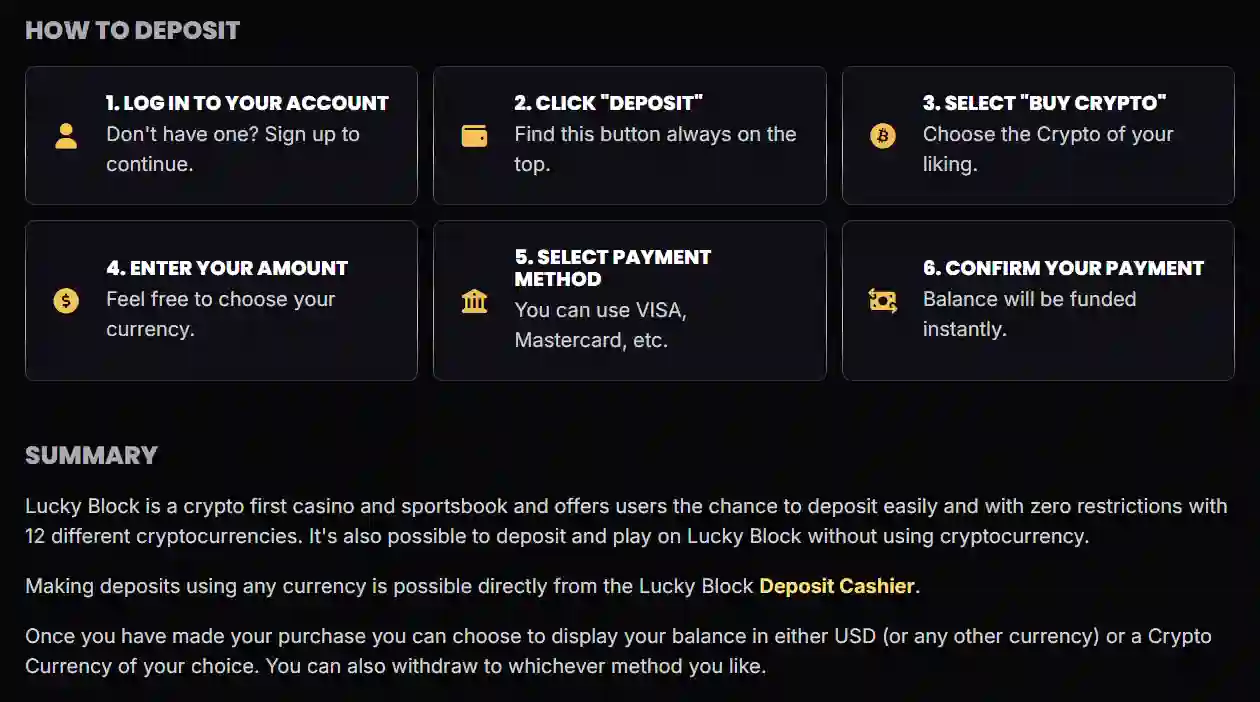
The currency name alone does not tell you which network a transfer uses. Tether, for instance, can be sent over different networks, and the receiving service must support the one you select. Before transferring funds, compare the casino’s deposit instructions with the network selected in your wallet. A mismatch can leave a payment inaccessible or lost, so do not assume that matching currency symbols are enough.
Fees and confirmation times can also differ between currencies and networks. A lower transfer cost does not make a route suitable if the receiving service does not support it, and a faster transfer does not change the casino’s withdrawal rules. Check the exact asset, network and destination details each time rather than relying on a previous transaction.
Stablecoins are intended to track the value of a conventional currency, but holding or transferring cryptocurrency still carries risk. Other coins can change in value between the time you deposit and the time you withdraw. That movement may affect what your balance is worth in Australian dollars, even if the number of coins shown in your account has not changed.
The term “anonymous cryptocurrency casino” can make a broad payment menu sound like a privacy guarantee. It is not. A casino accepting several coins does not, by that fact alone, establish how it handles identity checks or account information. Consider the currency list as a practical payment detail, not proof that a service is anonymous or that one option is best.

Casino Apps, Monitoring and Changing Access
An app can make an offshore casino feel separate from the wider internet, but installing it does not make your activity private or guarantee that access will continue. It is still a way of reaching an online gambling service. The app’s presence on your phone does not change the service’s status or place it beyond regulatory attention.
The Australian Communications and Media Authority (ACMA) actively monitors online gambling activity, including activity involving cryptocurrency. That matters if you are looking at an app advertised as an anonymous casino app: using a digital currency or an app interface does not mean the activity is invisible to the regulator. Monitoring does not, by itself, tell you what information is collected about a particular user or whether an individual account is being examined. Avoid treating claims of privacy as proof of either.
An app also cannot promise uninterrupted access. The service may change how it is reached, or the app may stop working as expected. An icon remaining on your device is not evidence that the service is available, safe to use, or protected from disruption. Nor does an app make a casino an Australian-regulated service or provide Australian consumer safeguards.
Key Considerations
- Crypto payments do not grant invisibility from regulatory monitoring
- App access does not guarantee uninterrupted service or safety
- Mismatched blockchain networks can lead to permanent loss of funds
- Anonymity labels are operator claims, not verified protections
Be careful about what you infer from labels such as “no-KYC” or “anonymous.” They describe claims made about an operator’s process, not a guarantee about what happens to your information or funds. An app should not be treated as a shield from monitoring, identity checks, or the risks of dealing with an offshore service.
If you choose to make a crypto transfer, check that the casino supports the exact blockchain network you intend to use. A mismatch can result in funds being lost. Also account for changes in cryptocurrency value between making a deposit and later withdrawing or converting funds: the amount’s value in Australian dollars can move during that time.
Before installing anything, consider whether you can verify who provides it and what permissions it requests. Do not assume that an app-store listing, a familiar-looking interface, or a promise of private access settles those questions. Keep your device secure, and do not rely on the app as a guarantee that the casino will remain reachable or that your activity will remain unseen.
Why Older Casino Lists Can Quickly Become Out of Date
A list of offshore casinos published in 2024 is a record of what its publisher described at that time, not proof that the same sites remain available or operate under the same conditions. Domains, payment arrangements and service terms can change. A name appearing on an old list does not confirm that an Australian reader can access the site now, or that its current claims about no-KYC access are accurate.
Changes to Australia’s rules on digital-currency payments are another reason to treat dated lists cautiously. A specialist review described the 2023 amendments as seeking to restrict operators from accepting digital currency payments from Australians. Separately, from 11 June 2024, licensed domestic wagering services in Australia could no longer accept credit cards or digital-currency transactions for wagering. That domestic rule does not, by itself, establish what an offshore casino currently accepts or whether its service is available to Australians.

The label “anonymous” can also outlast the conditions it was meant to describe. A past entry may say little about present identity checks, payment options or account requirements. Nor does a list establish that a site has Australian regulatory approval or that Australian authorities can provide consumer protection if something goes wrong.
Use an older casino list only as historical material, not as a current directory or assurance of status. Before relying on any claim, check whether it is dated and whether it is supported by current information from an accountable source. Treat missing dates and sweeping claims about anonymity as reasons for caution, not as evidence that a service remains unchanged. A list headed “anonymous casinos” cannot verify the experience you would have today.
What to Check Before Considering a New Casino
A newly encountered offshore casino can look established online while still leaving you with little recourse if something goes wrong. Before considering it, separate polished presentation from the protections that actually apply to you. Australian authorities do not regulate these operators, and you cannot rely on Australian consumer protections if a dispute arises.
Check the operator’s terms, payment rules and identity-verification requirements before providing personal details or funds. A “no-KYC” label is not proof that checks will never be requested, and an account described as anonymous does not guarantee privacy or uninterrupted access. Make sure you understand what information may be collected and what conditions apply to deposits and withdrawals.
Crypto adds another practical concern: its value can change between the time you deposit and the time you withdraw. Confirm the exact currency and blockchain network before sending anything; a transfer to the wrong network may be difficult or impossible to recover. Do not treat an unfamiliar site’s claims as a substitute for protections it cannot provide under Australia’s regulatory system.
If you cannot establish who operates the service, understand its terms, or accept the possibility of having no Australian authority to turn to, pause rather than rushing to deposit. A new name or a convincing interface does not change the operator’s position outside Australia’s framework.
Prepared by the Lucky Block Casino editorial staff.